Greg Zeck taught college English in Michigan, Iowa, Minnesota, and, one year way back when, as a Fulbright fellow in Serbia. After and between academic assignments, he also wrote and managed freelance business communications. He's retired now in Fayetteville, Arkansas, with his wife Jennifer, where he continues to read, write, bike, hike, and garden.
So the other day I was driving back from Kansas City with my wife. We’d gone there for the Labor Day weekend to visit our son and his girls, wife & daughter, who had just moved there when the daughter enrolled in her freshman year at KC Art Institute.
Driving back and listening for the first time in a while Fred Hersch’s jazz composition set to Whitman’s Song of Myself, I suddenly found myself crying. The tears of things, the tears that are in all things transient, pathetic, frangible, were flowing down my cheeks, and my wife, beside me, asked what was wrong. “Only,” I said, “that so many people will never hear or never realize this beauty.”https://youtu.be/_U6uiNDOxXI
Composer and pianist Fred Hersch. Kurt Elling and Kate McGarry are the voices in the YouTube recorded version cited here.
To realize this beauty, of course, like that in most complex jazz and classical compositions, may require a little education. And that is another question, a big one, which we’ll take up presently.
REVERIES. Ever have ’em? That in between, or liminal space, of consciousness where you are coming out of sleep but not yet awake? This word & phrase occurred to me this morning in such a state: “The tortured logic of PETTIFOGGERS.” On waking, or maybe just before, I realized this phrase made pertain to SCOTUS (the Supreme Court). Shit, I hadn’t seen or used that word, pettifog or its variants, in a long time, so looked it up & found:
verb (used without object)
1. to bicker or quibble over trifles or unimportant matters.
2. to carry on a petty, shifty, or unethical law business.
3. to practice chicanery of any sort.
In other and more familiar words, a pettifogger is a shyster, a word my lawyer father knew & was keen to hurl at ambulance chasers and other quasi-legal lawyers of that ilk.
The Supreme Court, June 2022. Seated from left are Justices Sonia Sotomayor, Clarence Thomas, Chief Justice John G. Roberts, Jr., and Justices Samuel A. Alito and Elena Kagan. Standing from left are Justices Amy Coney Barrett, Neil M. Gorsuch, Brett M. Kavanaugh, and Ketanji Brown Jackson. Credit: Fred Schilling, Collection of the Supreme Court of the United States
I would like to see just how, if at all, logically, by the light of day (if not at dawn’s early light), it might apply to the justices of the current Supreme Court.
But before such a rigorous exam, how about citing this delicious titbit from an NPR subsidiary:
According to etymologist Anatoly Liberman, a professor at the University of Minnesota, there’s a reason pettifogging sounds so much like “petty f***ing.”
Pettifoggers, shysters, and all kinds of hagglers have humble antecedents and usually live up to their names,” Liberman wrote in the Oxford University Press blog OUPblog.com back in 2010.
Liberman traced fogger’s Dutch/German roots:
The early Modern Dutch form focker was Latinized as foggerus, with -gg- in the middle. German has Focker, Fogger, and Fucker, none having any currency outside dialects. The OED cites them from the Grimms’ multivolume dictionary. (As is known, the OED had to bow to the morals of its time and excluded “unprintable” words, but in the entries where no one would look for them, offensive forms appeared: such is a mention of German fucker, with lower-case f, under fogger, and of windfucker “kestrel.”)
As for poetry, I don’t know I should ever like to attempt a poem about our pettifogging Supreme Court and the tortured logic of the conservatives on the court, as applied to the powers of the scoundrel Trump especially, but I like the idea of kestrel as windfucker.
If Gerard Manley Hopkins lived today … and loosened and vulgarized his clerico-poetic vocabulary just a bit, we might have a poem not about Jesus, but SCOTUS and POTUS, called not “The Windhover” but “The Windfucker.”
Let’s face it. Some days the poetic well is pretty dry. Try as you might, the quill just don’t dip the ink.
I’ve been working lately on an elegy, for example, a remembrance of a friend, who, like the rest of the mortal tribe, has moved offstage after his few lines. It’s been several years since his disappearance, however, and my thoughts and images are not as fresh as they might once have been.
This friend, Tom, committed suicide. He went not up garret, as poets do, but down basement, alas, in a house he had just bought near Little Rock, and opened canisters of nitrogen and propane gas. Soon the job was accomplished, and Tom’s psyche and soma were at peace.
Not too long afterward, some of his hiking friends gathered for a little memorial in the woods, each of us taking a turn to express what we felt at the moment. I recited an elegy I’d just composed, full of sentiment and perhaps sentimentality. We were all tear-struck, and perhaps fear-struck too, as if such an event might somehow descend on us too. Imagine that.
Tom Briggs A memorial in the woods
This is the place we can say what we
did not say when you lived among us.
That we considered you a friend.
That we suffered when you suffered.
That we smiled when you smiled,
which you did frequently, and had our
own debts and our own need for forgiveness.
How could we forget the time
at Little Sugar Creek when you got
drunk, drunker than the rest of us,
and sailing a rope over water,
suspended momentarily, a boy
forever, never planning to die,
crashed on the rocks of the far side.
Now this is the place we put an arm
around your shoulder, kiss your cheek,
give you the hug you might have missed
in life that says that nothing, really, can be
that bad, our friend, neither crushed knee,
nor crushing debt, nor exploded hopes —
there need be no such things — because
this is the place, finally, just this zone,
apart and tearful, where no one is alone.
Years later, I find myself composing, bit by bit, a book of elegies about people famous, infamous, or obscure. In this context, this poem might not carry the weight it needs in order to stand among my better efforts or attract the audience I would like. So it’s time to revise.
I delight in revising, in seeing again the things I have seen only imperfectly. But sometimes it’s tough to see much of anything clearly and sharply. Times, perhaps, when you wake up and aren’t awake. The coffee hasn’t yet snapped you out of sleep. And you sit in front of your tablet or computer wondering now what, what the devil should I do or say?
Tom with one of his ferrets on a hike at Devil’s Den State Park.
The first order of business, I think, as I might advise beginning poets, or open mic poets who have so much to say and are looking for a way to say it, is to replace some of the abstract or general ideas with images literal or metaphoric. In my case, I search through some Facebook pages that Tom kept and that friends commented on — and come up with a raftload of images:
He loved to watch the Perseid showers.
He was a “living alchemist.”
He was fond of making chemical explosions, e.g., he and a friend demolished an old metal barrel via flashpowder explosions, melting a cast iron skillet in the bargain.
Tom kept a pet ferret or two, little beasts he would bring hiking with him and insert into cracks in the rocks.
Tom had just recently bought a small brick ranch house near Little Rock, the place where he asphyxiated himself.
So where do these images come in? I’m not suggesting we cram everything we find into what we already have in hand. But certainly in such recollections, and in other hints that the environment throws at us, we can find a lot more that’s interesting, immediate, and to the point.
Let me show a bit of how I have revised this poem in progress, a form that is still finding itself through seeing and re-seeing, vision and revision. The opening stanza forsakes the memorial ceremony in the woods and goes elsewhere, something like this:
According to one witness, children
and animals adored him. Other
survivors attest to his annoying
alchemistry, tossing firecrackers
into campfires, blasting eardrums
with flashpowder. When he offed
himself, departing this world a bit
ahead of us, he left his champagne
ferret behind, the beast he’d insert
into sandstone fissures at Devil’s
Den till it came back again from
the Pennsylvanian and stuck its
pink nose once more into sunlight.
Reading a newish biography of the poet Hart Crane, about whose work I wrote a Ph.D. dissertation many moons ago. In doing so, I used the biographical as well as bibliographical work available at the time, especially early bios by Philip Horton (1937) and Brom Weber (1948), plus John Unterecker’s Voyager: A Life of Hart Crane (1969).
The newish bio (2002) is titled simply Hart Crane: A Life by the British writer Clive Fisher.
Expressionist portrait of Hart Crane by the Mexico painter David Alfaro Siqueiros (1931).
As far as I recollect, it supplies lots of material that Weber and Unterecker did not have access to, including discussions and evaluations of his homosexuality.
The title of this blog passage comes from a friend of Crane’s, Claire (Spencer) Smith, who in the summer of 1919 reacted in shocked disbelief when he suggested he became homosexual because she had refused to marry him:
… if I had not made such a mess of things, he would not have become a Homo. I asked him, “I don’t see why you should become a Fairy for any other reason except you are one.” He answered, and I remember that he was on the point of crying: “No one has ever told me that I was beautiful before.”
Well, we wouldn’t or couldn’t say fairy or homo today, would we, unless we were malicious and probably right wing? For we are restrained not only by politeness or politesse but correctness, yes? There are fearful fogs that restrain us and retrain us, for better or worse, in our speech habits.
Consulting Merriam-Webster, you will find that the words polite and politesse derive “from French, from Middle French, cleanness, from Old Italian pulitezza, from pulito, past participle of pulire to polish, clean, from Latin polire.” So we with manners, polished manners, will refrain from using unpolished and unsanctioned terms.
As for Crane himself, I’m not sure what vocabulary he used, in his day (1899-1932) to describe his sexuality. At the end of his life, it’s true, he had an erotic relationship with a woman, the ex-wife of a friend, but this attachment was not so strong, evidently, as to prevent him from soliciting sex from sailors on the ship on which he was returning from a year in Mexico to the US. And from which, beaten by the sailors and in despair, he threw himself to his death.
Bisexual, finally, anyone? Androgynous? Just fooling around? It doesn’t make that much a difference finally, I would think. Crane is gone, long gone, though his poetry remains and continues to excite admiration.
Last week I dropped in at Fayetteville’s only remaining independent bookstore for new books, Pearl’s, for a biweekly Writers Night I had not previously attended. Coming in new and cold is always a challenge. I had no idea what the meeting would be like, or who would show up, but found out soon enough in a rambling hour and a half.
Must’ve been hoping the Night would resemble the old monthly open-mic night at a previous indie bookstore, Nightbird, which started out big, dwindled, and finally crashed. The bookstore space dwindled, that is, and out went the cafe; a brewery moved in next store and thrived; the bookstore owner herself, may she rest in peace, died of cancer.
The open mic night at Nightbird, run by Ozark Poets and Writers, had been semi-curated: one main speaker was scheduled ahead of time, that is, and then on the night of the reading anyone could sign up for five minutes and try his or her luck with the listeners. As I recall, it was a lotta fun. I put in my two cents’ or five minutes’ worth several times, and we all got to hear some rambunctious verse.
When Pearl’s opened, about a half mile away, it attracted a good selection of local book readers and set up events, like Writers Night, for after hours. Necessarily, it could be, the focus from the start was more on commercial or pop genres than literary stuff. Pearl’s had to sell to stay alive, after all, in this not book-hungry day and age.
I don’t think the Pearl’s Writers Night is for me. There were about 15 people there, including me and Gerry Sloan, a poet friend and retired music professor; guests kept trailing in and eventually filled and overfilled the big table at the far end of the room.
Most were scifi and fantasy writers, or said they were. No one read anything. Instead, it was a free floating bull session facilitated by a gal who works at the bookstore.
Some intelligent and funny people, but I’m not interested in scifi or other pop genres nor, at this stage of the adventure, in helping newbie writers.
Better to stick with, and fortify, seems to me, existing poetry groups or those waiting to be born in whatever form.
Don’t you too want to take a chance with an open mic? To test out your ideas, images & voice? You may not have a ghost of a chance unless you put your name in the hat. Come on. We’ll call you up a bit later in the evening. Meanwhile, buy a soda or a beer from the eager to please store owners.
Every night, someone suggested recently at a writers’ meeting, you write down an event or idea from the day that might be used in a story. Or a poem, I should add. Or essay. Or whatever.
You might call this a writer’s night music, eine kleine Nachtmusik, a la Mozart, if you wish.
Mostly, this exercise is a bit of discipline, a way of reminding yourself that a writer writes every day, willy nilly, sun or rain, conflagration or tornado, in order to build up that night or day music. (When did Shakespeare write King Lear and work up the gods that keep the dreadful pother o’er our heads? During a raging storm, in fact? or a sunny day? does anyone really know and does it matter? He had noted such storms, obviously, maybe played with them, one night or day on parchment, and had them ready to go when Lear was germinating in his head.)
So here’s an idea from today, an image, something to add to the escutcheon that is the story, or poem, or book we would write eventually:
At every street corner, every doctor’s office, every restaurant, there are signs. Signs that we might, with a little attention, take as wonders. I don’t mean as miracles that should direct our lives or tell us where we’re going, simply stuff that someone has written and we might wonder about. Take this example, posted in the clinic where my wife is getting PT for her busted ankle, alas:
Hmmmm, gotta wonder over this one, don’t you?
What is the distance here, I wonder, between respecting a healthcare worker and attacking him or her? How is respect accorded, and what does it mean? You (maker of signs, maker of wonders) aren’t suggesting here, are you, that a doctor, say, is automatically worth the kind of reverential respect often given? And that if he or she is not, the only option is to attack? (Of course, they may be fending off this aggressive notion preemptively by assuring us that they respect us!)
Okay, okay, such signs are not philosophy, or psychology, are they? Or fine writing, for that matter? Pretty approximate, usually. If healthcare workers have been attacked, or think they’re about to be, not a bad idea to warn aggressive or plain crazy people out there in the waiting (and seething) room.
But how many of us, seeing such signs, don’t gotta wonder what the healthcare workers and administrators are getting at? Hmmm, let’s scratch our heads and think it over.
TBC (as in our next novel or epic poem “Demise of the Healthcare Workers”).
Poets are interested in language, is that a surprise? In the way language works, its twists and turns, its quirks and oddities, its strengths and its obscurities, its absurdities.
In the sounds of words, their musicality, no matter how opposed to sense the music may be.
Words, after all, are a social contract and contact. We agree that cat is “a small domesticated carnivore, Felis domestica or F. catus, bred in a number of varieties.” That nose is “the part of the face or facial region in humans and certain animals that contains the nostrils and the organs of smell….” And that faith is, among other things, “a system of religious belief” (all definitions from www.dictionary.com).
But what happens in the poet’s brain that urges him to reinforce and yet at the same time break out of convention?
There’s the play of the sound of words, for one thing, as I say above. Play is pleasure, it’s not duty. Play is erotic, if sublimated eros.
Let me give an example from my musings today, if you can call them that.
I was at the gym, exercising, when I had to get back into my locker. But there was someone sitting in front of it, blocking my access, someone I had never seen before. I asked, politely enough, if I could reach the lock on the locker, that “fat lock,” I called it, suddenly, for the shackle of the lock I use is so fat that it’s hard to get it through the hole in the locker handle.
“Fat lock!” I said again to the stranger. “Is that something like a fetlock, which is something a horse has?”
Yes, indeed, it’s a fetlock. Right down there near the ground.
Hell, he didn’t know, and I didn’t either at the moment. It’s one of those words, fetlock, that you probably don’t know unless you’ve been around horses. And, if you know it once, as I once did, you may forget it. Or know it only imprecisely.
But the dictionary knows, and keeps on knowing, as I soon realized: fetlock, “a projection bearing a tuft of hair on the back of the leg above the hoof of a horse or similar animal…. the tuft of hair itself” (www.merriam-webster.com/dictionary).
Shortly afterward, back on the gym floor, I approached one of the leg machines I use frequently, but it bore a sign saying “Out of Order.” Maybe because of the equine exchange with the stranger, I read it as “Out of Ordure.” Oh, horse shit! I moved on to another machine.
And when my wife texted me, as I was finishing the workout, “Don’t forget the broth” (for I was to pick up turkey broth for tomorrow’s Thanksgiving Day feast), I assured her I was on the task. “I am the broth,” I responded, “the truth, and the light.”
To veer from horse droppings to bible verses, however twisted, may be the sign of a twisted mind. Or a mind twisted away from duty, anyway; convention; and consecutive logical thought, even the logic of simple transactions. Would you please pick up some broth? Oh, bother, sister, brother! My brain has detoured me once again.
The mind is distracted, deserts the task at hand, the duty. But comes up, nevertheless, with some interesting diversions, or divertimenti, or beginnings.
No, these crazy phrases are not a poem. But may be the start of one. Of something other than an order fulfillment, at any rate.
Recently with my son I attended a viewing of Demi Moore’s new film The Substance — which is an icky one indeed, including tons of barfing, bleeding, and fleshly grotesqueries. I liked the film, despite my general aversion to sci fi and horror. This was a film that indulged yet transcended the pop genres.
It’s a fable about the difficulties (horrors) of growing old in a youth- and beauty-oriented culture, both in Hollywood and the hinterland. The protagonist of the film, Elizabeth Sparkle, played by Demi Moore, is a TV aerobics star but at the nadir of her apex. She’s 50 years old or so, in other words, and her studio boss, played by a hilariously despicable Dennis Quaid, tells her she’s through. The show needs fresh meat.
To make a long, long story (two hours, twenty minutes) short, she makes a Faustian bargain for something called the Substance, ducking into a back alley as if for an abortion and finding, every time she does so, in an immaculate and sterile room, a rejuvenating kit with instructions.
Back home at her luxury penthouse, Elizabeth shoots up and falls to the bathroom floor, writhing, quaking, her back splitting open grotesquely — not exactly Eve from Adam’s rib but a much younger version of herself, a gal named Sue (Margaret Qualley), who will go on to take Ms. Sparkle’s part on the aerobics show.
Thing is, the instructions make it clear that the two women must change places every week. There is only so much of the substance, apparently, and when Sue is done with her week she must yield to Liz. But Sue cheats, syringing out more days’ worth of the substance from Liz’s back, through a gaping, sucking porthole, than is specified. When she overdoes her stay by a day or two, Liz grows older.
The first sign of this aging is a bony index finger — crooked, scaly, brown! — the first sign of a rapidly advancing infirmity, thanks to Hollywood’s special yucky effects department.
Elizabeth Sparkle isn’t sparkling anymore.
Sure, Sue goes on to become the aerobics star, if only briefly, and then to be signed to lead a spectacular New Year’s gala, but she too succumbs to the Substance. As the gala is to commence, she lurches onstage, late, hunched over, over her face a piece of paper smeared with a red lipstick mouth. What better reaction to Quaid’s admonition that “pretty girls always smile”?
Critics have knocked the film as too much horror, and too many grotesque special effects, and it is pretty difficult to sit through for as long as it goes on (especially the ludicrous blood- and yuck-spewing of the final scene at the New Year’s show).
But it’s a powerful fable, as I say, of the illusions of our day. Do we need to be knocked over the head (barfed on) to get the point? Apparently. How many of us won’t go home from the viewing without thinking (shuddering) not so much about losing our youth … but about losing our minds to the infantile preoccupations with youth and appearance?
True, there’s no character in the film, no authorial point of view that stands for the critic, that develops a complex critical thesis, but, hey, this is the movies. It’s a corporeal film and delivers a corporeal impact. Not only the barfing and bleeding and spewing of all kinds, but the more sedate, even painterly nudity: I didn’t mind seeing a naked Demi Moore, even at 50, and her younger self, played by Margaret Qualley, half her age, but these images do not appeal to prurient interest (at least not mine).
I’m not 26 anymore, or even 52, but I look at the gray in my hair, the wrinkles in my face, the keratoses on my skin, and laugh. The maculae, the imperfections, are what I’ve earned — how about you? — by living the perilous adventure we call life.
William Shakespeare (1564–1616), the greatest writer in the English language.
I’ve been married more than 50 years. And to the same woman. Which puts both her and me in a fairly rare category.
Jennifer’s father, a part-time evangelical minister, performed the wedding ceremony, in fact, at their house, which sits on Lake Minnetonka, in the western Minneapolis suburbs. It’s a pretty poshy place now, but way back when Max bought it on the cheap, about $15,000 and a used travel trailer. It had been a lodge in the 1930s and ’40s, and in fact the family called it “the lodge.” We were married in a big hall, with a picture window looking out over the lake.
As I recall, Max had us recite the standard marriage vows — no dithering, no quibbling, but “love and honor” if not, at his daughter’s insistence, “obey.” That would be taking it too far back into the patriarchal past. So it was “love and honor” we both vowed “till death do us part.”
Over the years, like most married couples, we have had ample occasion to question our union. There have been the usual frictions over love and money and the usual divergence of interests and hobbies. Jen is a homebody, a wonderful cook and entertainer, and not much interested in athletic or corporeal exercises. I’ve learned to be more outgoing, to lead hikes and bike rides, to socialize easily even with strangers.
But one of the things that really has challenged our marriage is that I’ve become, since my 50s, increasingly hard of hearing. Have had to ask for Jen, and others of course, to repeat what they said, sometimes several times. And this is exasperating for all concerned.
It occurred to me this morning, somehow (who knows how these poetic or lunatic associations occur), that our vows might just as easily have been “till deaf do us part.”
Well, I’ve been wearing hearing aids the last 15 years. If I am wearing them, I can hear pretty well. And heed pretty well what’s being asked or said.
It’s true that Jen’s paternal grandfather, Walt, was also quite hard of hearing. In his day, back in the 1970s, when Jen and I were married, he would solve the problem of his wife’s considerable shrewishness by simply winking at others in the room and turning his hearing aids way down or off.
That’s one way to tame the shrew, yes? Or get around her? Or around yourself and your limitations.
Shakespeare’s first folio, dated 1623, seven years after his death, of Hamlet’s to be or not to be soliloquy.
Jen and I are still together, almost 54 years post-wedding, and working even now on the deaf- and-death parting business. We’ve had occasion, recently, in our golden (crumbling) years to approach more nearly the mystery of death, what Henry James called “that distinguished [extinguishing?] thing.” There’ve been bouts of illness, that is, that remind us, pretty sharply, of “The undiscovered country from whose bourn / No traveler returns,” as Hamlet says).
What we say, in response, in defiance even, when possible, is that life continues to be good, and love, until deafness and death do us part.
Following up and for now concluding the exercise of the last two posts, let me show, and also tell a bit, about what happened to the early versions of the poem on Wallace Stevens.
The nonce stanzaic forms, or no-forms, that appeared above struck me as being in need of shaping. The first stanza went, remember, like this:
Yet what he said who knew? He was poet,
after all, not executive, not poohbah
of the boardroom. He wrote,
he did not underwrite. He took,
he did not undertake. He was
focused, not schizwit.
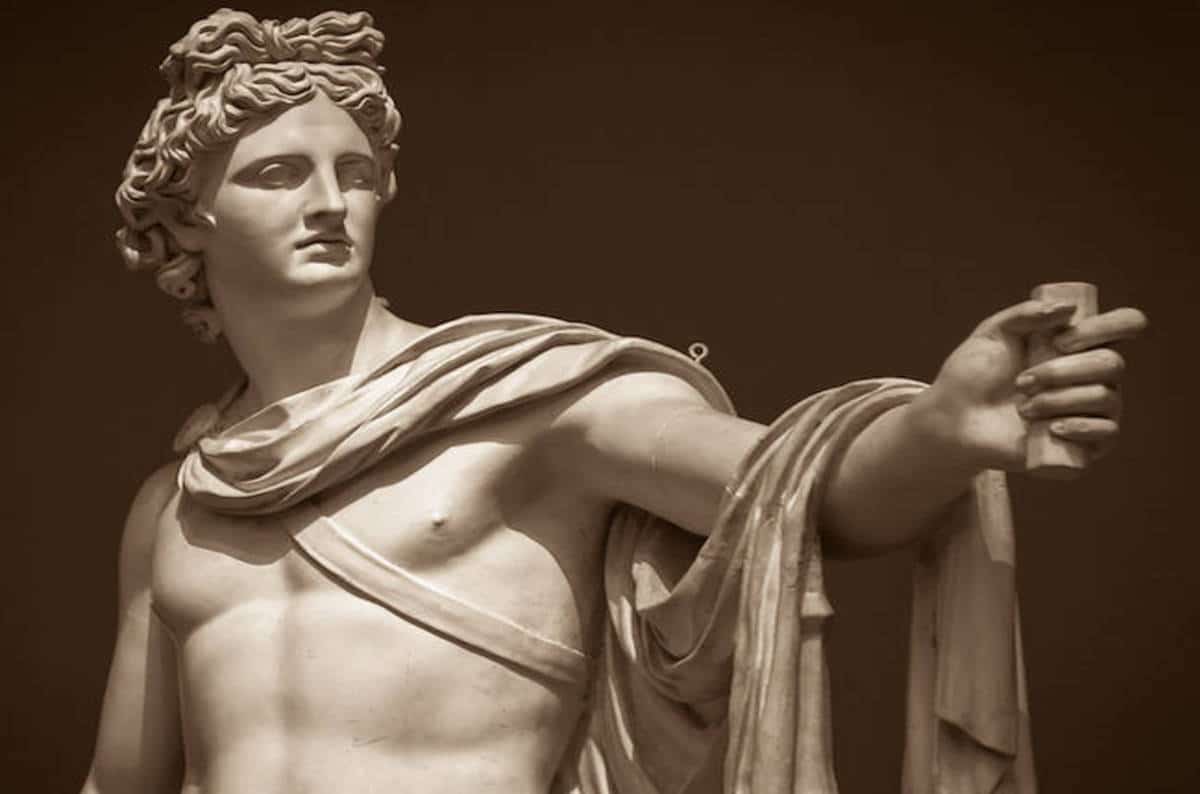
The Belvedere Apollo, originally in the Belvedere Gallery of the Vatican Museum in Rome.
And the second stanza drizzled down in very skinny lines to what I’d wanted to be a resounding ending.
Better, I thought, to achieve some sort of equity, or equal apportioning, of lines among the stanzas. And to slow down the motion — and leave more room for rest and contemplation, even in going, on the reader’s part. So I divided the content into more or less equal-length stanzas, and eliminated a few of the promising but misleading ideas of the original (the “shizwit,” for example).
And came up, for now, with this:
Hartford
Yet what he said who
knew in the insurance
company? He was poet,
apart, not executive
of the boardroom,
sitting godlike, throwing
thunderbolts, decreeing
policy: simply legally
enforce it. He would write
not underwrite, take
not undertake, the letter
of the law, and when he left
the office for his home,
walking back the three
miles he had trod that
very morning, the letters
forming in glory, in words
that effloresced, he wore
them like the casque
of the sungod that he was.
So we have three stanzas, in order: seven lines, six lines, seven lines. A nice symmetry, easier on the eye, the tongue, the ear. And more compact in the pursuit of theme. Though Stevens had a job in business, and was in fact an executive of the Hartford Accident and Indemnity company, he exercised his power not in Jovian thunderbolts but Apollonian splendor.







 It’s true that Jen’s paternal grandfather, Walt, was also quite hard of hearing. In his day, back in the 1970s, when Jen and I were married, he would solve the problem of his wife’s considerable shrewishness by simply winking at others in the room and turning his hearing aids way down or off.