How to get going when the going gets tough

Let’s face it. Some days the poetic well is pretty dry. Try as you might, the quill just don’t dip the ink.

I’ve been working lately on an elegy, for example, a remembrance of a friend, who, like the rest of the mortal tribe, has moved offstage after his few lines. It’s been several years since his disappearance, however, and my thoughts and images are not as fresh as they might once have been.

This friend, Tom, committed suicide. He went not up garret, as poets do,  but down basement, alas, in a house he had just bought near Little Rock, and opened canisters of nitrogen and propane gas. Soon the job was accomplished, and Tom’s psyche and soma were at peace.

Not too long afterward, some of his hiking friends gathered for a little memorial in the woods, each of us taking a turn to express what we felt at the moment. I recited an elegy I’d just composed, full of sentiment and perhaps sentimentality. We were all tear-struck, and perhaps fear-struck too, as if such an event might somehow descend on us too. Imagine that.

Tom Briggs
A memorial in the woods

This is the place we can say what we
did not say when you lived among us.
That we considered you a friend.
That we suffered when you suffered.
That we smiled when you smiled,
which you did frequently, and had our
own debts and our own need for forgiveness.

How could we forget the time
at Little Sugar Creek when you got
drunk, drunker than the rest of us,
and sailing a rope over water,
suspended momentarily, a boy
forever, never planning to die,
crashed on the rocks of the far side.

Now this is the place we put an arm
around your shoulder, kiss your cheek,
give you the hug you might have missed
in life that says that nothing, really, can be
that bad, our friend, neither crushed knee,
nor crushing debt, nor exploded hopes —
there need be no such things — because
this is the place, finally, just this zone,
apart and tearful, where no one is alone.

Years later, I find myself composing, bit by bit, a book of elegies about people famous, infamous, or obscure. In this context, this poem might not carry the weight it needs in order to stand among my better efforts or attract the audience I would like. So it’s time to revise.

I delight in revising, in seeing again the things I have seen only imperfectly. But sometimes it’s tough to see much of anything clearly and sharply. Times, perhaps, when you wake up and aren’t awake. The coffee hasn’t yet snapped you out of sleep. And you sit in front of your tablet or computer wondering now what, what the devil should I do or say?

No photo description available.
Tom with one of his ferrets on a hike at Devil’s Den State Park.

The first order of business, I think, as I might advise beginning poets, or open mic poets who have so much to say and are looking for a way to say it, is to replace some of the abstract or general ideas with images literal or metaphoric. In my case, I search through some Facebook pages that Tom kept and that friends commented on — and come up with a raftload of images:

    • He loved to watch the Perseid showers.
    • He was a “living alchemist.”
    • He was fond of making chemical explosions, e.g., he and a friend demolished an old metal barrel via flashpowder explosions, melting a cast iron skillet in the bargain.
    • Tom kept a pet ferret or two, little beasts he would bring hiking with him and insert into cracks in the rocks.
    • Tom had just recently bought a small brick ranch house near Little Rock, the place where he asphyxiated himself.

So where do these images come in? I’m not suggesting we cram everything  we find into what we already have in hand. But certainly in such recollections, and in other hints that the environment throws at us, we can find a lot more that’s interesting, immediate, and to the point.

Let me show a bit of how I have revised this poem in progress, a form that is still finding itself through seeing and re-seeing, vision and revision. The opening stanza forsakes the memorial ceremony in the woods and goes elsewhere, something like this:

According to one witness, children
and animals adored him. Other
survivors attest to his annoying
alchemistry, tossing firecrackers
into campfires, blasting eardrums
with flashpowder. When he offed
himself, departing this world a bit
ahead of us, he left his champagne
ferret behind, the beast he’d insert
into sandstone fissures at Devil’s
Den till it came back again from
the Pennsylvanian and stuck its
pink nose once more into sunlight.

 

Taking shape

Following up and for now concluding the  exercise of the last two posts, let me show, and also tell a bit, about what happened to the early versions  of the poem on Wallace Stevens.

The nonce stanzaic forms, or no-forms, that appeared above struck me as being in need of shaping. The first stanza went, remember, like this:

Yet what he said who knew? He was poet,
after all, not executive, not poohbah
of the boardroom. He wrote,
he did not underwrite. He took,
he did not undertake. He was
focused, not schizwit.

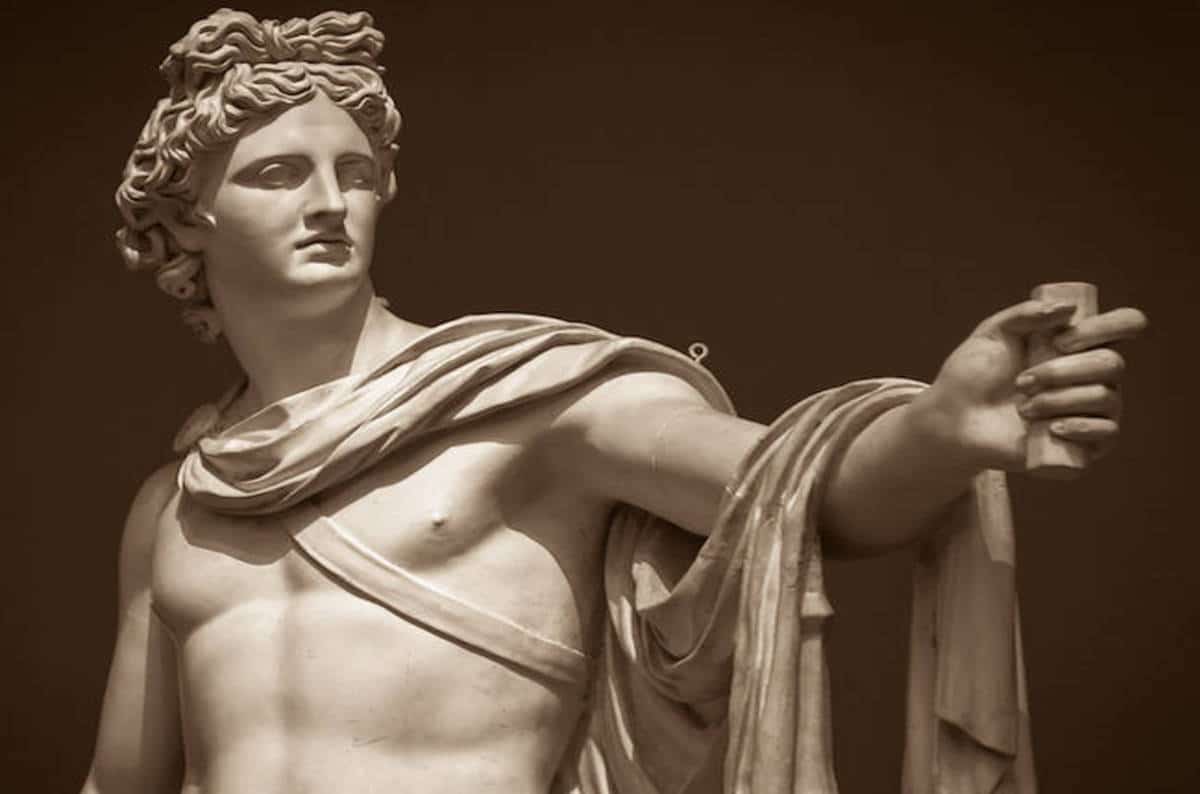
Apollo Greek God
The Belvedere Apollo, originally in the Belvedere Gallery of the Vatican Museum in Rome.

And the second stanza drizzled down in very skinny lines to what I’d wanted to be a resounding ending.

Better, I thought, to achieve some sort of equity, or equal apportioning, of lines among the stanzas. And to slow down the motion — and leave more room for rest and contemplation, even in going, on the reader’s part. So I divided the content into more or less equal-length stanzas, and eliminated a few of the promising but misleading ideas of the original (the “shizwit,” for example).

And came up, for now, with this:

Hartford 

Yet what he said who
knew in the insurance
company? He was poet,
apart, not executive
of the boardroom,
sitting godlike, throwing
thunderbolts, decreeing

policy: simply legally
enforce it. He would write
not underwrite, take
not undertake, the letter
of the law, and when he left
the office for his home,

walking back the three
miles he had trod that
very morning, the letters
forming in glory, in words
that effloresced, he wore
them like the casque
of the sungod that he was.

So we have three stanzas, in order: seven lines, six lines, seven lines. A nice symmetry, easier on the eye, the tongue, the ear. And more compact in the pursuit of theme. Though Stevens had a job in business, and was in fact an executive of the Hartford Accident and Indemnity company, he exercised his power not in Jovian thunderbolts but Apollonian splendor.

Which is certainly one way to make your mark.

More sweat, no sweat

Sweating it out
Even sweat is no sweat when work is play. Image: Jeff Lipsky.

To continue sweating over what may be the beginning of a poem, a new poem, maybe an ekphrastic poem (done in imitation of another objet d’art).

To continue sweating, and yet swearing it’s no sweat, it’s fun. At least that’s how I find playing with language, and playing is the essence of the game. It’s form more than content, especially at the start, and form creates the content that is.

“I gotta use words when I talk to you,” said T. S. Eliot, another crucial modernist. But what words, what words we talking here?

Our own, we would hope, even when interfused with those of the poet we are imitating. For if imitation is flattery it also may mean flattening, drowning in another’s voice.

So taking up, carefully, consciously, playfully, where we left off:

Yet what he said who knew? He was poet,
after all, not executive, not poohbah
of the boardroom. He wrote,
he did not underwrite. He took,
he did not undertake. He was
focused, not schizwit.

This is pretty tight but, sure, frankly imitative of Stevens: especially poohbah and schizwit. If this is a tribute, an ekphrasis, that’s one thing. But it if means to launch out, rocket like, from the gantry of another’s voice, that may be something else altogether. Will these words, launched, in other words, find their own orbit?

To this end, let’s play around with what we have, taking out the Stevensian effects:

Yet what he said who knew?
He was poet, after all, not
executive. He would not
sit godlike at the head,
executing policy,
throwing thunderbolts,
but enforce it. He would
write, not underwrite.
Take, not undertake,
the letter of the law,
and when he left
the office for his
home, walking
back the three
miles he had
trod that
morning,
the letters
formed in
glory, in
full words,
and he wore
them like the
helmet of the sun
god that
he was.

Well, good gods, I have gotten ahead of myself here, you see. Forgotten that I was to shape the sestet into another sestet. Got wordy, perhaps, adding ideas but not yet shaping them.

Proof if anything that I may be in the early stages of development. But let that be as it may. I can always go back, recursively, you see, and press and mold these words into six-line stanzas if that’s that they seem to want or warrant.

But now merely letting some ideas play, along with the nascent shapes and sounds of the words. Here it’s the idea that Stevens didn’t want to be too much a businessman or lawyer, though he was that gladly during the workday. From what I surmise in the Brazeau book (see yesterday’s post), he would sometimes fiddle around with words in the office, even have his secretary type up a few lines, and then he’d stash ’em in the lower right-hand drawer of his desk.

But as I’m fooling around here I’m operating under poetic license, with no oath of fidelity to the letter of the law or the law itself.

The office was one realm for Stevens, an earthly realm. The home, and the walk home, were another, a celestial realm, a place of resting from work and wrestling with the angel of the word, a place of contemplation (aside too from the wife, with whom Stevens did not share a bed or bedroom for many years, for poetry was his muse, his mistress, you see).

As a matter of course, to make the process clearer, I take early versions of a poem, early drafts, and print them up as I go along. Let them rest and breathe on the desk a day or two. Fiddle with them with my pencil, crossing out certain words or phrases, asking questions. And then waiting for the next, I hope clearer, vision of the whole when I come back the next day and have at it.

So let’s see what will happen tomorrow, shall we? Or what already has?