Poets are interested in language, is that a surprise? In the way language works, its twists and turns, its quirks and oddities, its strengths and its obscurities, its absurdities.
In the sounds of words, their musicality, no matter how opposed to sense the music may be.
Words, after all, are a social contract and contact. We agree that cat is “a small domesticated carnivore, Felis domestica or F. catus, bred in a number of varieties.” That nose is “the part of the face or facial region in humans and certain animals that contains the nostrils and the organs of smell….” And that faith is, among other things, “a system of religious belief” (all definitions from www.dictionary.com).
But what happens in the poet’s brain that urges him to reinforce and yet at the same time break out of convention?
There’s the play of the sound of words, for one thing, as I say above. Play is pleasure, it’s not duty. Play is erotic, if sublimated eros.
Let me give an example from my musings today, if you can call them that.
I was at the gym, exercising, when I had to get back into my locker. But there was someone sitting in front of it, blocking my access, someone I had never seen before. I asked, politely enough, if I could reach the lock on the locker, that “fat lock,” I called it, suddenly, for the shackle of the lock I use is so fat that it’s hard to get it through the hole in the locker handle.
“Fat lock!” I said again to the stranger. “Is that something like a fetlock, which is something a horse has?”
Yes, indeed, it’s a fetlock. Right down there near the ground.
Hell, he didn’t know, and I didn’t either at the moment. It’s one of those words, fetlock, that you probably don’t know unless you’ve been around horses. And, if you know it once, as I once did, you may forget it. Or know it only imprecisely.
But the dictionary knows, and keeps on knowing, as I soon realized: fetlock, “a projection bearing a tuft of hair on the back of the leg above the hoof of a horse or similar animal…. the tuft of hair itself” (www.merriam-webster.com/dictionary).
Shortly afterward, back on the gym floor, I approached one of the leg machines I use frequently, but it bore a sign saying “Out of Order.” Maybe because of the equine exchange with the stranger, I read it as “Out of Ordure.” Oh, horse shit! I moved on to another machine.
And when my wife texted me, as I was finishing the workout, “Don’t forget the broth” (for I was to pick up turkey broth for tomorrow’s Thanksgiving Day feast), I assured her I was on the task. “I am the broth,” I responded, “the truth, and the light.”
To veer from horse droppings to bible verses, however twisted, may be the sign of a twisted mind. Or a mind twisted away from duty, anyway; convention; and consecutive logical thought, even the logic of simple transactions. Would you please pick up some broth? Oh, bother, sister, brother! My brain has detoured me once again.
The mind is distracted, deserts the task at hand, the duty. But comes up, nevertheless, with some interesting diversions, or divertimenti, or beginnings.
No, these crazy phrases are not a poem. But may be the start of one. Of something other than an order fulfillment, at any rate.
Even sweat is no sweat when work is play. Image: Jeff Lipsky.
To continue sweating over what may be the beginning of a poem, a new poem, maybe an ekphrastic poem (done in imitation of another objet d’art).
To continue sweating, and yet swearing it’s no sweat, it’s fun. At least that’s how I find playing with language, and playing is the essence of the game. It’s form more than content, especially at the start, and form creates the content that is.
“I gotta use words when I talk to you,” said T. S. Eliot, another crucial modernist. But what words, what words we talking here?
Our own, we would hope, even when interfused with those of the poet we are imitating. For if imitation is flattery it also may mean flattening, drowning in another’s voice.
So taking up, carefully, consciously, playfully, where we left off:
Yet what he said who knew? He was poet, after all, not executive, not poohbah of the boardroom. He wrote, he did not underwrite. He took, he did not undertake. He was focused, not schizwit.
This is pretty tight but, sure, frankly imitative of Stevens: especially poohbah and schizwit. If this is a tribute, an ekphrasis, that’s one thing. But it if means to launch out, rocket like, from the gantry of another’s voice, that may be something else altogether. Will these words, launched, in other words, find their own orbit?
To this end, let’s play around with what we have, taking out the Stevensian effects:
Yet what he said who knew? He was poet, after all, not
executive. He would not
sit godlike at the head,
executing policy,
throwing thunderbolts,
but enforce it. He would
write, not underwrite.
Take, not undertake,
the letter of the law,
and when he left
the office for his
home, walking
back the three
miles he had
trod that
morning,
the letters
formed in
glory, in
full words,
and he wore
them like the
helmet of the sun god that
he was.
Well, good gods, I have gotten ahead of myself here, you see. Forgotten that I was to shape the sestet into another sestet. Got wordy, perhaps, adding ideas but not yet shaping them.
Proof if anything that I may be in the early stages of development. But let that be as it may. I can always go back, recursively, you see, and press and mold these words into six-line stanzas if that’s that they seem to want or warrant.
But now merely letting some ideas play, along with the nascent shapes and sounds of the words. Here it’s the idea that Stevens didn’t want to be too much a businessman or lawyer, though he was that gladly during the workday. From what I surmise in the Brazeau book (see yesterday’s post), he would sometimes fiddle around with words in the office, even have his secretary type up a few lines, and then he’d stash ’em in the lower right-hand drawer of his desk.
But as I’m fooling around here I’m operating under poetic license, with no oath of fidelity to the letter of the law or the law itself.
The office was one realm for Stevens, an earthly realm. The home, and the walk home, were another, a celestial realm, a place of resting from work and wrestling with the angel of the word, a place of contemplation (aside too from the wife, with whom Stevens did not share a bed or bedroom for many years, for poetry was his muse, his mistress, you see).
As a matter of course, to make the process clearer, I take early versions of a poem, early drafts, and print them up as I go along. Let them rest and breathe on the desk a day or two. Fiddle with them with my pencil, crossing out certain words or phrases, asking questions. And then waiting for the next, I hope clearer, vision of the whole when I come back the next day and have at it.
So let’s see what will happen tomorrow, shall we? Or what already has?
If you’re a poet, you know how it goes. What seems to be a spark of a poem — an image, a rhythm — hits you first, and off you go, like a test firework, one of the little ones that warm up the crowd. And so it goes a few lines at a time, could be, till you stand back, scratch your head, wonder what if anything you might have here.
So it goes with me, at times, and I’d like to delve here a bit into the process just to see if it’s anything of value to myself or readers; if it’s any help in any practical, or for that matter impractical, way.
This last weekend I picked up a couple of poetry books at a local used bookstore, one by a poet-friend Gerry Sloan, the other a collection of recollections by those who had known Wallace Stevens, lawyer and insurance executive and great American poet (1879-1955) in one capacity or another, Parts of a World: Wallace Stevens Remembered, by Peter Brazeau.
There are so many good directions and lines in this collection, so many throwaway lines you might think, unless you gather them up, I must have felt, and do something with them. And so I began inscribing them, or something like:
He wrote quite beautifully, they said, though his hand was up and down, up and down, his signature a rocket launch going PFFFT! or MUMMMM! though surely that’s not what he wrote.
We all know the bit about doctors’ illegible handwriting. But here it’s the fastidious lawyer Stevens, vice president in the claims department, whose signature seemed to his colleagues at Hartford Accident and Indemnity Company all but unreadable. They joked that his John Henry looked like MUMMM, and called Stevens Mr. Mumm. (Reticent and often silent in the company of those he did not know, or did not like, he was not the usual back-slapping insurance man.)
My first line above, “He wrote quite beautifully,” addresses Stevens’ style. Evidently, as a lawyer, Stevens was clear, logical, precise, and everybody appreciated that. As a poet, however, he was baffling, at least to his practical-minded insurance company colleagues. According to the testimony of Brazeau’s book, they seem to be uniformly puzzled. One typical reaction: “I’ve tried to read his poetry, and to me it’s the biggest bunch of gobbledygook.” A polite way of saying “bullshit,” I suppose, but as Stevens observed to several of these people they were too literal-minded to understand poetry.
Now here I must confess that, in writing even these few prose paragraphs, I have seen fit to revise the opening of the poem I give above. I wrote above, in paragraph one, about how starting a poem is like “a test firework,” and only subsequently added that image to the first stanza of the poem, Stevens’ handwriting becoming a “rocket launch,” an image that seems to reinforce the shape and force of Stevens’ hand.
What I scribbled next has a few right rhythms, could be, or images, but is rough, rough, rough:
Yet what he said who knew? He was a poet, after all, and the others merely executives, too literal minded he advised to understand. It was a world of underwriting
and sureties, of odds and evens, some of them odder than others, oddities you might say, and they surmised he was schizophrenic, after all, mixing poetry and insurance; locking up wife and daughter at the little bungalow, from which, daily,
he would sally forth to the office, and there perhaps scribble
in a dewy notebook a few lines that occurred along the way; dictate them to his secretary and have her file ’em away
in the right hand file drawer.
This is too verbose, you see. Too many words (as the emperor in Amadeus says about Mozart’s work: too many notes) … and not well enough chosen or spliced in.
So we go back to work and hack our way through this jungle of first thoughts or inspirations.
I like the first sentence: it’s short: it’s to the point: its rhythm is right:
Yet what he said who knew?
And it’s more in accord with the length and punch of the first six lines.
So now what? It’s not that the next few lines are wrong. It’s that they’re slack, or as Stevens says in an admirably taut and funny early poem, “Bantams in Pine-Woods,” “Fat! Fat! Fat! Fat!”
He seems to position himself here in “Bantams” as poet of the New World, battling not practical men, lawyers or insurance men, but Old World poets and their pretenses. (“Bantams” was published in 1922 and made its way, the next year, into Stevens’ famous first volume, Harmonium. It was a declaration of modernism.)
Fat! Fat! Fat! Fat! I am the personal. Your world is you. I am my world.
You ten-foot poet among inchlings. Fat! Begone! An inchling bristles in these pines …
So if past is prelude, including the past of early modernism, by god we can do worse than follow Stevens’ example. For example,
Yet what he said who knew? He was poet, after all, not executive, not poohbah of the boardroom. He wrote, he did not underwrite. He took, he did not undertake. He was focused, not schizwit.
OK, so this is rough, too, and maybe silly. (One can get giddy silly under Stevens’ early Harmonium example of a hundred years ago.) But it’s taking shape, acquiring a tighter form. Notice I’ve repeated here the idea of the sestet, or six-line stanza, an idea that seems popular these days in the little magazines, for even without pre-modernist rhyme or meter a poem looks tighter when arranged in neat stanzas.
What’s a schizwit anyway? (I’m interested in schizophrenia, for sure, having experience among family and friends.) Do poets, whether ten-footers or inchlings, use neologisms to proclaim or to define? And how much room do we have to do so?
In a world of underwriting, of sureties, odds and evens, they surmised he was schizophrenic, mixing poetry water and insurance oil. What did they know? Who? Who? Hoo! He kept wife and daughter locked in the cellar.
Well, you get the drift, and it’s still drift for sure. Am I going toward, or away, from an idea? A central idea, you might say. Getting anywhere? Or gliding toward a form?
It’s impossible, could be, to separate form and idea in poetry. If you haven’t got the one, how can you have the other? But let’s come back to this, shall we, before too long? This poem, I mean. This process of revising and seeing new. This relation of form and idea.
In Primer for Forgetting: Getting Past the Past, a gift from a friend who like me will soon enough pass, Lewis Hyde cites a spooky passage from an Orphic poem (“The Hymn of Orpheus”) of the 4th Century BC. It’s not the earth that we need fear forgetting, but the heavens themselves and the gods, the poem suggests.
In the halls of Hades you will find on the right, by a ghostly cypress tree, a spring where the dead souls descending wash away their lives. Do not even draw close to this spring for it offers [only] the Waters of Forgetfulness.
Farther on you will find the pool of Memory. Over this stand guardians. They will ask with keen mind what is your quest in the gloom of deadly Hades. Tell them the whole truth straight out. Say: “I am the child of Earth and starry Heaven, but of Heaven is my true lineage. I am parched with thirst and perishing: give me quickly chill water flowing from the pool of Memory.”
Assuredly the kings of the underworld take pity on you, and will give you water from the spring; then you, when you have drunk, traverse the holy path which other initiates and bacchants tread in glory. After that you will rule among the other heroes.
The Greek text is set to music in this video.
How to forget that which doesn’t really matter, our life on Earth? And remember that which does, our life before our Earthly life?
Is this a little Platonic for you, or neo-Platonic?
It’s not the verbal spring from which we drink every day, for sure. It’s a paradox: we must forget in order to remember, die in order to live.
A little too Christian or salvific?
How about, more simply, poetic? To be a poet, or maker, we must cast aside that which doesn’t matter, which is matter itself, paradoxically, and all that matter begets. Mother, we might cry, like the dying old man in Chaucer, let me in! And in this reverse birth seize that which does matter, the starry Heavens, the starry night, and day of making things anew.
Ran into the poem below on Facebook, where a friend had posted it. Did not know of this poet, Danusha Laméris, until now. She’s a keeper and winner, for sure.
What do we do with such illuminations? Read ’em and weep? Read ’em and smile? Read ’em and reflect on how they can be applied, if there’s such a thing as applied poetry, to our daily lives?
Gods know we are still tribal, even if, as the poet says, we are “So far / from tribe and fire.” We huddle in our own, old prejudices, I mean, and when we meet others we growl or bite.
Isn’t this especially true, these days, of politics?
Better to lavish on each other, however transient these exchanges, a smile, a helping hand? Even when we suspect the other guy/gal is crazy? As crazy as we are ourselves?
Small Kindnesses
by Danusha Laméris
I’ve been thinking about the way, when you walk
down a crowded aisle, people pull in their legs
to let you by. Or how strangers still say “bless you”
when someone sneezes, a leftover
from the Bubonic plague. “Don’t die,” we are saying.
And sometimes, when you spill lemons
from your grocery bag, someone else will help you
pick them up. Mostly, we don’t want to harm each other.
We want to be handed our cup of coffee hot,
and to say thank you to the person handing it. To smile
at them and for them to smile back. For the waitress
to call us honey when she sets down the bowl of clam chowder,
and for the driver in the red pick-up truck to let us pass.
We have so little of each other, now. So far
from tribe and fire. Only these brief moments of exchange.
What if they are the true dwelling of the holy, these
fleeting temples we make together when we say, “Here,
have my seat,” “Go ahead—you first,” “I like your hat.”
All it takes, sometimes, for a poem to spring to mind, just about full blown, like Athena from Zeus’s head, is a word. So this song of the moment.
CONTRAINDICATED
My wife, with a degree
in medical science,
or so you’d think
by the kind of advice
she dispenses, suggests
that many of my (bad)
habits, like drinking
and drugs, I mean
innocuous drugs like
melatonin ’cause how
can a guy with all my
bad habits fall asleep
without drugs, and
did I mention goat
like lechery, are
contraindicated,
a forbidding way,
don’t you think,
of looking on
life’s little
lethal pleasures?
After starting as a Yeats ephebe, John Berryman (1914–1972) became a wild man in his own voice in his Dream Songs.
Following another prompt in Matthew Zapruder’s book Why Poetry, I’d like to explore a bit the connection between dream and poetry, as it applies to a couple of modern poets and myself, to the practice of conjuring it up from the depths.
I have a poet friend who calls me a mole poet. He sees me making subterranean tunnels with my words, evidently. And in truth I like the idea of a mole, a metaphorical mole at any rate, with its star-shaped snout in the loam. (What poem am I forgetting to remember that has that image of the mole’s star-shaped nose? Now my neighbors, some of my neighbors, in the excellent exurban development where I live, have moles if not poetry, which is to say they have literal and problematic moles in their yards that plow up their lawns from below, but what I’m talking about here is real moles in imaginary gardens, the way Marianne Moore in her much revised and many-versioned poem “Poetry” talks about toads, positing in an early version that real poets create “for inspection, imaginary gardens with real toads in them.”)
And now, thanks in good measure to Zapruder’s prompt, I see what my poet-friend might be getting at. There is something in my lines that comes up from below, some subterranean or chthonic thing, some leak between down there and up here where we are said to be pleased to live. (Even Arkansas, where I have been pleased to live, in retirement, the last ten years or so, though it proclaims itself “the natural state,” is not necessarily the leaky state or known for the vatic fumes coming up from below. I have hiked all around this beautiful natural state and not seen yet one sybil squatting on her tripod amidst the fumes from the underworld and foretelling one damned thing, even something as natural as watch it, buddy, or you’ll break your leg on that rock!).
But hold on a minute, please. I’d like to quote Zapruder here, at least the first time he brings up (as from below) this idea of poetry as dream. He is talking here about how he came up with the idea of the book and how he meant to explain poetry to a reluctant and busy up-in-the-head audience:
… I knew the main idea would be that poetry does something different than all other forms of writing and speech, something essential, something we need.
I would demonstrate this by writing about old poems, and also contemporary ones. I would discuss the mechanisms of poems: form, and rhyme, and metaphor, and symbols. I would reveal that what is strange about poetry—its dream logic, its interest in the slipperiness and material qualities of language, its associative daydreaming movement—is not some deliberate obfuscation, or an obstacle to communication, but essential to the very way poetry makes meaning.
Excellent and exciting prompts, no? Poetry “does something different than all other forms of writing and speech”! And if it’s so different, how can we expect to read it, or “appreciate” it, without knowing what that “something different” is and how it achieves poetry’s essential qualities that are essential to living in this upper world?
Hart Crane, some time in the 1920s.
Poetry’s strange “dream logic,” which Zapruder does not define here, brings up for me a couple of immediate associations, perhaps daydreamy associations, from my study of poetry, the cases of two poets I have read and written about and enjoyed, Hart Crane (1899–1932) and John Berryman (1914–1972), both of them visionaries, you might say, and stylists, and both of them alcoholics and suicides. (Crane wrote the long poem The Bridge and jumped from the bridge of a ship sailing back from Mexico where he had been living to the United States. Berryman wrote The Dream Songs and jumped from a bridge over the Mississippi River connecting the east and west banks of the University of Minnesota, which I attended as an undergraduate.)
How about these dream-logic lines from Crane’s “Voyages, II”:
—And yet this great wink of eternity,
Of rimless floods, unfettered leewardings,
Samite sheeted and processioned where
Her undinal vast belly moonward bends,
Laughing the wrapt inflections of our love …
In part I of Voyages (1924), he cites kids frolicking on the beach, but in II his vision moves outward, beyond the safety of the land, beyond the conventionally knowable. These are wonderful lines about the sea, how it winks, teasing and beckoning us toward eternity where, willy-nilly, we will go some day. It goes beyond all bounds we know (“rimless”), whether logical or perceptual, and catches up the mystical musings of Melville and Moby-Dick (the lovely image of “unfettered leewardings”). No, the sea is a queen, covered with precious cloth (samite = “a heavy silk fabric, sometimes interwoven with gold, worn in the Middle Ages,” dictionary.com) and pregnant with mysterious meaning (“undinal,” from undine, a female water spirit). She laughs, or laps, “the wrapt inflections of our love” (Crane was in love with a sailor and dedicated Voyages to him).
Crane called his dream logic “the logic of metaphor” (about which I wrote a Ph.D. dissertation how many eons ago), which he defended to dubious editors like Harriet Monroe when he submitted to Poetry magazine his lyric “At Melville’s Tomb.”
But enough for now. You see how wholly unlike Crane’s language is from everyday language. It’s precious, it’s dreamy, it’s as unlikely to occur in business speech as cocktail chitchat. (Well, more unlikely in business!) It’s love-poem language, and so much beyond the roses-are-red bromides of greeting cards and everyday consciousness that it’s not funny. Not funny, no, but could be stunning. Give in, it whispers. Go with the dream flow. Let yourself be swept away, fall in love, fall out of the world of conventional logical meaning and thought.
John Berryman, my 2nd exhibit of dream language here, began his poetic career as a conventional imitator of the Big Poets of his time, namely, W. B. Yeats and W. H. Auden, two Brits then at the apex of the mid-20th century poetry game. But he figured, all by his lonely, as all good poets eventually do, that his own voice was something else. He wrote a longish tribute poem called Homage to Mistress Bradstreet (1956) and then, starting in 1964 the Dream Songs, 18 line poems in 3 stanzas. Here’s the beginning of No. 8:
The weather was fine. They took away his teeth,
white & helpful; bothered his backhand;
halved his green hair.
They blew out his loves, his interests. ‘Underneath’
(they called in iron voices), ‘understand,
is nothing. So there.’
Such quick colloquial phrases! Such ironic juxtapositions! Is what’s happening here something that happens in the real world? Fine weather and then the teeth removed? Backhand? Is this tennis, or the back of a hand used to strike? Green hair of a young man? Surely, JB was no punk before his time! Like birthday candles, “loves” and “interests” are blown out at death, and death is “‘Underneath,'” as this poem too, in its insistent dreamy logic, takes us underneath the obvious, the everyday. We seem to sway, reluctantly, could be, in a mortuary environment. We’re made to look, however horrible or horribly funny, at the corpse. (More than Crane, Berryman was haunted by the idea of suicide from a young age; when JB was just 12, his father, like Hemingway’s father, shot himself, and hung like an albatross around the son’s neck —sorry about the mixed metaphor! — until the son too pulled the trigger or jumped.)
Finally, let me offer, immodestly and logically enough, my own example. From my second book of poetry, released October 2021, consider this poem:
Hot Thai Dinner chez Zeck
Kelly comes over and chews some shrooms,
holding them in his mouth as long as possible,
like a lover the first time he kisses a woman
he’s been wanting forever or a smack of caviar.
Holly eats the hot Thai take-out and fire pours
from her head, a petite bronze bodhisattva
exhaling Thai food who wants nothing to do
with Thai food. Kelly and I are laughing like
two baboons chewing the shrooms, what do
we want with food at a time like this? Jen’s
dish is way hot too, the way she was when
we just met, I could hardly get in the door
without whipping it out and we fell moaning
to the floor while upstairs her parents sat
grazing on Bonanza.
I make no particular claim for the worth of this poem or its value vis-à-vis others being written today. But the logic of the progression of lines and images suggests dream or associative logic more than everyday, conventional logic. Now, it may be true that shroom lovers or potheads or alcoholics, for that matter, associate like this more easily than most people most of the time. Most people most of the time don’t jump like this from one image or idea to the next.
There’s the simile in line 3, comparing the chewing of magic mushrooms to the kissing of a long-desired woman. (Oral pleasures, baby!) There’s the comparison in line 6 of the petite Holly to a bodhisattva, a figure of enlightenment or exception (she’s not chewing shrooms, apparently, but hot Thai food). There are the two baboons that Kelly and the poet become when chewing shrooms. And, finally, there’s the hot dish Jen eats, and the poet remembers how, way back when, when he and Jen were newly met and not yet wed, they fell at each other hungrily while the parents, upstairs in the logic room, are grazing on the convention moral logic of Bonanza on TV.
Well, I tend to free-associate like this every day, in speech as well as poetry; it’s my everyday logic, if not others’. A habit of mind that stands me apart at times, where well I should be, as the habit makes some people uncomfortable. It also makes for a lot of free-association joking, and I’m able to entertain people this way and coax them out of the stuffy environment of work and duty.
Logic and duty, then, on one hand. Poetry and jokes and dreams, on the other. Zivili! as we used to toast each other in Serbia, where I taught one year way back when. Long and happy life!
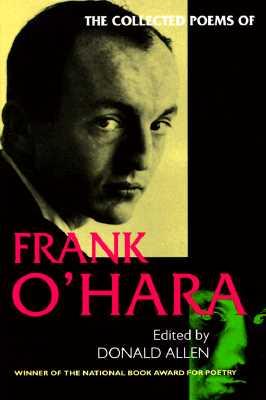
Frank O’Hara, 1926–1966, was in the habit of tossing around scraps of poetry. Some were found in his chest of drawers after his death.
Got a message from a friend who was having trouble with the poems in my 2nd volume, Lost & Found: Poems Found All Around. He appeared to question why he had to consult the dictionary and look up words. Like most people who don’t read much poetry and are not practiced at reading it, he would probably not consider consulting a dictionary to be a lot of fun.
In a recent book, Why Poetry, however, Matthew Zapruder suggests that the dictionary is exactly what you should consult when you read poetry. If you don’t know a word, look it up, he says, for what you need in poetry first of all is the literal sense of the word. When you understand the individual words, the poem will make more sense, at first a literal sense, then perhaps something more. Only then will you be able to connect the denotations of words with connotations or connections.
The more of the surface of the poem you understand, and perhaps discuss with others, the more of the depths of the poem and the interconnectedness of the parts of a poem you will understand. And not just understand but feel and be affected by.
Let’s look at a few unusual words from a sample poem in Lost & Found, and see how this poem may model how poetry makes more sense when you understand the individual words and how they work together.
Poem I’ve Been Hoarding in a Drawer Thinking of Frank O’Hara
Sure, socks, tees, and bikini briefs cohabit
in this fine and private place, grave of a sere
and obscure drawer. And when scraps of poetry
also, stray spraints or scats, pack of street mutts,
anoesis of barks, sniffs, scratches, are found here
one day, after I am gone, stuff I hid away, a dusty
cluster of what might have been, and perhaps was,
back in the day: okay, okay, okay.
The title, first, makes use of the operative verb hoard. Is this a pirate’s treasure we’re talking about? Whoa, now! Before we jump to metaphoric conclusions, let’s define hoard in its most familiar, literal sense. To hoard is to stow or hide something away, yes? To store something up and save it from consumption, maybe against a rainy day, maybe against our fears that sooner or later we’ll have nothing at all left in our hands.
If we hoard something in a drawer, we’re saving or keeping it against use or consumption. In this case it’s both underwear (“socks, tees, and bikini briefs”) and a poem, this poem, that are being hoarded. A strange combo to hoard in a drawer, to be sure.
Then comes a series of unusual, and maybe unfamiliar, words: sere, a rather archaic word for dry; spraints, which means otter feces, and scats, animal feces in general; and anoesis, “a state of mind consisting of pure sensation or emotion without cognitive content” (dictionary.com), which with the modifying phrase “of barks, sniffs, scratches,” suggests some kind of doggy mentation at a pretty basic animal level.
So, the situation is a bit strange, or strained, or not exactly realistic or literal. We have underwear in a drawer and also scraps of poetry, maybe unfinished or unpolished poems. And these unlike objects coexist and somehow belong in, or have been filed in, the same place (by the poet). The phrase fine and private place is an allusion to a 17th century seduction poem, familiar to students of poetry if not the general public, by Andrew Marvell, “To His Coy Mistress,” where the poet says as he nears the climax of his seductive pitch:
The grave’s a fine and private place,
But none, I think, do there embrace.
Marvell is in a hurry to get it on with his mistress, and she’s still resisting. He admonishes her to do it, do it now, before they’re both dead and can feel nothing at all.
The poet of “Poem I’ve Been Hoarding in a Drawer” is not pleading with a lady, but making something of an erotic connection between the hidden contents of a drawer — intimate garments like underwear, that is, and intimate feelings contained in poems. For isn’t that one of the things that poems do best? Talk honestly about things most of us keep to ourselves, perhaps forever, never uttering, never getting off our chests and out of our hearts? True, this particular poet, in this particular poem, has hid poems away: perhaps he doubts the wisdom of presenting them to the world. He’d be opening himself to the cold gaze of the world of duty, service, subservience, convention, it could be.
But in the end, at the end of the poem, he seems to be resigned to the eventual discovery of these poems, these feelings,
stuff I hid away, a dusty
cluster of what might have been, and perhaps was,
back in the day: okay, okay, okay.
Whatever intimates he might have worn, or intimate feelings he might have had, pinned to his sleeve, worn on his face, or tucked out of sight, they are all gone now, you see, except, for this poem (and others like it).
Now I may seem to be making something more ingenious out of the poem than it ever consciously was. I swear that when I wrote it, I did not start or proceed from a rational outline or moral thesis. The poem simply came to me, pretty quickly, and I relied, as often happens, at least as much on sound as on sense. The origins were not much more than anoesis, believe me: scratching, sniffing, barking.
Poets are suckers for sounds. (They have not been weaned perhaps from these oral pleasures and onto the hard, dry facts of the working world.) In the mouths of poets, words are musical and magical things, even dream things, as Zapruder also suggests. But in the end words also must make sense.
In the minds of readers, especially those who do a little homework, as with the dictionary, sound and sense can merge to make a wondrous and affecting experience. Given a bit of time and effort, poetry will make more sense than the brevity of a piece like “Hoarding” might suggest. But poetry will never appeal to readers the way a page-turning novel does. They are completely different creatures, and if poetry requires time, study, patience it can repay us a thousand times for our efforts.
It’s as tough today to write a convincing poem about political issues as it was during the Depression. A poem that is not strident, dogmatic, and beside the point — if we concede that the point of poetry today, as in the past, is to explore the new, not turn over the old and obvious.
(The dictionary definition of poetry is worth citing here: “the art of rhythmical composition, written or spoken, for exciting pleasure by beautiful, imaginative, or elevated thoughts.” Even if we know that in the wake of war, catastrophe, and civil unrest, elevated thoughts are not as easy to produce as an elevator ride up to haberdashery, say. And beauty itself comes often in camouflage.)
In today’s arts climate, in fact, the new PC orthodoxies are already old, tired, obnoxious, and obvious.
They harken back to the revolutionary foment of the Depression, when either you were with us or against us (a dedicated leftist, even commie).
Skeptic poets Steve Petrini (left) and Greg Zeck, with Mrs Petrini, an admirable animal doctor, in between.
Wallace Stevens, 1879–1955, was one poet dedicated to verse, however perverse and even, in some of his verse, he acknowledged, ironically, “otiose prettiness.” He was a poet, the maker of new things that would last and stay; a reformer, he thought, in poetry and politics, but not a young revolutionary. He would not “take the point of view of a poet just out of school” (see The Whole Harmonium: The Life of Wallace Stevens by Paul Mariani).
As per today’s young wet-behind-the-ears firebrands, certain words may be allowed. Other words not. Certain attitudes are admirable; others detestable. Certain races and sexual preferences, which have long been “privileged,” must yield to new privileges for minorities and LGBTQ+ (whatever plus is: is it back there in the dark somewhere with Bed, Bath & Beyond?).
If you’re looking to submit literary work to a little magazine and read what the editors are looking for, chances are very high you’ll find among their desiderata the word “diversity” and its half-demented cousins.
My 2nd book of poetry, just released, Lost & Found: Poems Found All Around, contains a poem, in fact, “What We’re Looking For,” based entirely on such editorial shibboleths. Harken if you plan on submitting to our magazine, the editors counsel:
We seek mysteries and marginalized voices, a sense of shared wonder, inclusive art that asks questions, explores mystery, and works to make visible the marginalized, the overlooked, and those whose voices have been silenced, including LGBTQ+, neurodivergent writers, women and women writers.
Heavens help us all. If we could write no better than this clod of an editor, how could we get into any magazine? (I know! Let’s found our own magazine … and welcome those who look, act, think, and smell like us! Neurodivergent writers, whatever that means! If we can’t find an acronym, we’ll use jargon! Don’t let English get in the way!)
I would hope, that among us older, more experienced, more reflective literary artists, diversity could signal an artist who has the most words, the supplest syntax, the most exploratory mind. What does it matter if he or she is white, black, red, yellow, straight or queer?
Use your experience in life, yes, and in letters — and let it rip. Don’t be shy. Don’t hold back. Don’t whine about who might go tut-tut-tut. Too many editors and critics are truculent little whiners. Let them whine. Go your way and make it a journey.
In my 70+ years’ experience in reading, writing, teaching, living, and, yes, like you, suffering, I’ve become who I am today — a human being with a lot to say … and a way of saying it. A voice, in short, that does not rely on acronyms, jargon, and petty-minded formulae.
So, please, sir editor or madame, when I grace your journal with a submission, don’t throw me an 18-year-old reader as your first line of defense, someone who’s read little if anything of the literature of the last 100 years. And may be armed primarily with the prejudices of hisr youthful generation. (There’s a pronoun suggestion for you: hisr. His or her. I’m afraid “hers” is already taken and “their” is, believe it or not, plural.)
If you’re looking for mystery, Ms. or Mr. Editor, look at the words of the writer. The words should be true to the writer’s experience in his or her world and in craft. If she has been silenced or, perhaps more accurately, participated in silence, she needs to develop a voice of her own so she’ll have something to say and a way of saying it.
Her voice can’t merely cry weh ist mir! or how persecuted I am!
Get a life, young lady, young gentleman. A life in writing. Learn to write, that is. Dare to stumble, fall. Get up and stumble again. And when you get up, for gods’ sakes revise!
Writing is a lonely craft. You’re on your own. Get on with it.
If you’re on social media, you may have noticed poetry groups. They are a kind of epiphenomenon, a wart or wonder on the face of language enterprises generally.
Pardon my cynicism. But it’s in the service of a decent cause, I think: skepticism that good poetry can be produced by people who write but don’t read poetry.
Why do so many people write poetry? Is it a good thing that they do?
We might cheer the general idea that poetry should be more popular or more prevalent in our culture. Songs are popular, are heart and soul of pop culture. And it may not matter much that most song lyrics are bad.
Politics is a matter of general concern, though most of us aren’t particularly articulate about our political views. Yes, we complain. But do we know how to bring the country together? (A politically motivated view of poetry is expressed by minorities, like the lesbian writer Julie S Enszer, in an opinion piece called “Are Too Many People Writing Poetry?” Her view is that the more we have of minority opinions, the better. But minority opinions from untrained voices do not necessarily make good art. And such opinions, these days, overload the literary journals.)
Whether motivated by song or politics, poetry should be written by people who have read it and even studied it.
Otherwise, the idea of poetry is cheapened.
Why so many poets or poetasters? We all want to express ourselves.
The problem is knowing how to do so.
We all want to distinguish ourselves from the animals, some of whom have articulate voices or a bit of same. Crows and parrots can imitate language. Bulls and bears can roar and grunt.
But it’s only human beings that have articulate speech.
Some more, some less.
If speech is to become poetry, the speaker must know something about craft. Like other crafts, and arts, poetry has evolved through the centuries. So those who write poetry in the early 21st century should not sound like they’re speaking from the 18th or 19th or even 20th century.
Polly Put the Kettle On, so we’d all have tea. Which is great. But this move doesn’t guarantee good poetry.
But tons of would-be poets today sound just like that. They mistake rhyme as the crucial element of poetry, not an accessory or even accident. They are guilty of what Chaucer calls “drasty [nasty] rhyming.” By god, friends, if we have to go this pilgrims’ road together, let’s have some decent rhyming at the very least. And, what’s better, some attention to what really constitutes poetry in the 21st century.
Heightened speech, I would say. Rhythmic speech. And access to articulate ideas from all sources, written and spoken.
Poetry is a tough business, as I’ve said before. Not for sissies. Not for whiners. Or for those who expect instant praise or give up easily.
So today read a poem. Go to Poetry Foundation, for example, and dig around a bit. Why not? it will spare you from the drasty rhyming found in poetry groups on Facebook and other muddied sources.