Sound vs. sense: the poet’s mind

Poets are interested in language, is that a surprise? In the way language works, its twists and turns, its quirks and oddities, its strengths and its obscurities, its absurdities.

In the sounds of words, their musicality, no matter how opposed to sense the music may be.

Words, after all, are a social contract and contact. We agree that cat is “a small domesticated carnivore, Felis domestica or F. catus, bred in a number of varieties.” That nose is “the part of the face or facial region in humans and certain animals that contains the nostrils and the organs of smell….” And that faith is, among other things, “a system of religious belief” (all definitions from www.dictionary.com).

But what happens in the poet’s brain that urges him to  reinforce and yet at the same time break out of convention?

There’s the play of the sound of words, for one thing, as I say above. Play is pleasure, it’s not duty. Play is erotic, if sublimated eros.

Let me give an example from my musings today, if you can call them that.

I was at the gym, exercising, when I had to get back into my locker. But there was someone sitting in front of it, blocking my access, someone I had never seen before. I asked, politely enough, if I could reach the lock on the locker, that “fat lock,” I called it, suddenly, for the shackle of the lock I use is so fat that it’s hard to get it through the hole in the locker handle.

“Fat lock!” I said again to the stranger. “Is that something like a fetlock, which is something a horse has?”

Fetlock Injury in Horses
Yes, indeed, it’s a fetlock. Right down there near the ground.

Hell, he didn’t know, and I didn’t either at the moment. It’s one of those words, fetlock, that you probably don’t know unless you’ve been around horses. And, if you know it once, as I once did, you may forget it. Or know  it only imprecisely.

But the dictionary knows, and keeps on knowing, as I soon realized: fetlock, “a projection bearing a tuft of hair on the back of the leg above the hoof of a horse or similar animal…. the tuft of hair itself” (www.merriam-webster.com/dictionary).

Shortly afterward, back on the gym floor, I approached one of the leg machines I use frequently, but it bore a sign saying “Out of Order.” Maybe because of the equine exchange with the stranger, I read it as “Out of Ordure.” Oh, horse shit! I moved on to another machine.

And when my wife texted me, as I was finishing the workout, “Don’t forget the broth” (for I was to pick up turkey broth for tomorrow’s Thanksgiving Day feast), I assured her I was on the task. “I am the broth,” I responded, “the truth, and the light.”

To veer from horse droppings to bible verses, however twisted, may be the sign of a twisted mind. Or a mind twisted away from duty, anyway; convention; and consecutive logical thought, even the logic of simple transactions. Would you please pick up some broth? Oh, bother, sister, brother! My brain has detoured me once again.

The mind is distracted, deserts the task at hand, the duty. But comes up, nevertheless, with some interesting diversions, or divertimenti, or beginnings.

No, these crazy phrases are not a poem. But may be the start of one. Of something other than an order fulfillment, at any rate.


Spark, Spunk, Inspiration, Perspiration

If you’re a poet, you know how it goes. What seems to be a spark of a poem — an image, a rhythm — hits you first, and off you go, like a test firework, one of the little ones that warm up the crowd. And so it goes a few lines at a time, could be, till you stand back, scratch your head, wonder what if anything you might have here.

So it goes with me, at times, and I’d like to delve here a bit into the process just to see if it’s anything of value to myself or readers; if it’s any help in any practical, or for that matter impractical, way.

This last weekend I picked up a couple of poetry books at a local used bookstore, one by a poet-friend Gerry Sloan, the other a collection of recollections by those who had known Wallace Stevens, lawyer and insurance executive and great American poet (1879-1955) in one capacity or another, Parts of a World: Wallace Stevens Remembered, by Peter Brazeau.

There are so many good directions and lines in this collection, so many throwaway lines you might think, unless you gather them up, I must have felt, and do something with them. And so I began inscribing them, or something like:

He wrote quite beautifully,
they said, though his hand was
up and down, up and down, his
signature a rocket launch going
PFFFT! or MUMMMM! though
surely that’s not what he wrote.

Wallace Stevens: de dood van een soldaat | Remy in Wonderland

We all know the bit about doctors’ illegible handwriting. But here it’s the fastidious lawyer Stevens, vice president in the claims department, whose signature seemed to his colleagues at Hartford Accident and Indemnity Company all but unreadable. They joked that his John Henry looked like MUMMM, and called Stevens Mr. Mumm. (Reticent and often silent in the company of those he did not know, or did not like, he was not the usual back-slapping insurance man.)

My first line above, “He wrote quite beautifully,” addresses Stevens’ style. Evidently, as a lawyer, Stevens was clear, logical, precise, and everybody appreciated that. As a poet, however, he was baffling, at least to his practical-minded insurance company colleagues. According to the testimony of Brazeau’s book, they seem to be uniformly puzzled. One typical reaction: “I’ve tried to read his poetry, and to me it’s the biggest bunch of gobbledygook.” A polite way of saying “bullshit,” I suppose, but as Stevens observed to several of these people they were too literal-minded to understand poetry.

Now here I must confess that, in writing even these few prose paragraphs, I have seen fit to revise the opening of the poem I give above. I wrote above, in paragraph one, about how starting a poem is like “a test firework,” and only subsequently added that image to the first stanza of the poem, Stevens’ handwriting becoming a “rocket launch,” an image that seems to reinforce the shape and force of Stevens’ hand.

What I scribbled next has a few right rhythms, could be, or images, but is rough, rough, rough:

Yet what he said who knew? He was a poet, after all,
and the others merely executives, too literal minded
he advised to understand. It was a world of underwriting
and
sureties, of odds and evens, some of them odder than others,
oddities you might say, and they surmised he was schizophrenic,
after all, mixing poetry and insurance; locking up wife
and daughter at the little bungalow, from which, daily,
he
would sally forth to the office, and there perhaps scribble
in
a dewy notebook a few lines that occurred along the way;
dictate them to his secretary and have her file ’em away
in the right
hand file drawer.

This is too verbose, you see. Too many words (as the emperor in Amadeus says about Mozart’s work: too many notes) … and not well enough chosen or spliced in.

So we go back to work and hack our way through this jungle of first thoughts or inspirations.

I like the first sentence: it’s short: it’s to the point: its rhythm is right:

Yet what he said who knew?

And it’s more in accord with the length and punch of the first six lines.

So now what? It’s not that the next few lines are wrong. It’s that they’re slack, or as Stevens says in an admirably taut and funny early poem, “Bantams in Pine-Woods,” “Fat! Fat! Fat! Fat!”

He seems to position himself here in “Bantams” as poet of the New World, battling not practical men, lawyers or  insurance men, but Old World poets and their pretenses. (“Bantams” was published in 1922 and made its way, the next year, into Stevens’ famous first volume, Harmonium.  It was a declaration of modernism.)

Fat! Fat! Fat! Fat! I am the personal.
Your world is you. I am my world.

You ten-foot poet among inchlings. Fat!
Begone! An inchling bristles in these pines …

So if past is prelude, including the past of early modernism, by god we can do worse than follow Stevens’ example. For example,

Yet what he said who knew? He was poet,
after all, not executive, not poohbah
of the boardroom. He wrote,
he did not underwrite. He took,
he did not undertake. He was
focused, not schizwit.

OK, so this is rough, too, and maybe silly. (One can get giddy silly under Stevens’ early Harmonium example of a hundred years ago.) But it’s taking shape, acquiring a tighter form. Notice I’ve repeated here the idea of the sestet, or six-line stanza, an idea that seems popular these days in the little magazines, for even without pre-modernist rhyme or meter a poem looks tighter when arranged in neat stanzas.

What’s a schizwit anyway? (I’m interested in schizophrenia, for sure, having experience among family and friends.) Do poets, whether ten-footers or inchlings, use neologisms to proclaim or to define? And how much room do we have to do so?

In a world of underwriting,
of sureties, odds and evens,
they surmised he was schizophrenic,
mixing poetry water and insurance oil.
What did they know? Who? Who? Hoo!
He kept wife and daughter locked in the cellar.

Well, you get the drift, and it’s still drift for sure. Am I going toward, or away, from an idea? A central idea, you might say. Getting anywhere? Or gliding toward a form?

It’s impossible, could be, to separate form and idea in poetry. If you haven’t got the one, how can you have the other? But let’s come back to this, shall we, before too long? This poem, I mean. This process of revising and seeing new. This relation of form and idea.

End to End Solutions and Other Absurdities of Jargon

Listening to NPR the other day when I heard a sponsor mention “end to end solutions.” Good God, I thought, thinking as a poet would, or a student of language, or a pornographer, I don’t want to connect ends with a tube or any other conveyance of solutions. Of course, in business jargon “solution” itself is the dead-metaphor solution to all problems: just name ’em, there’s a solution. (Scant honor for the solids and gases.) Look at freeway traffic a few minutes: how many trucks will you see plying by with the word “solution” emblazoned on their side?

Antonyms for jargon

We get tired of the cliches and jargon of the business world because it permeates our consciousness so easily. We begin to think in these terms, or not-think, repeating the jargon as if it represented something true.

Beware of cliches, jargon, mind-altering and -alienating language. We are being used. We’re the consenting tool of our own demise.

We hear ad nauseam that someone is “impacted” by an event. What! Was he hit on the side if not front of the head? Was he in fact “compacted”? After the event did he allow his brain to repeat the mantra and reproduce it, so that every time he means simply “affected” he says “impacted”? Oh, he took a hit, so sorry, and had no idea of the damage.

I raise these concerns not to make everyone a poet or philologist but simply to make us a bit more aware of how repetitive, lazy language captures us and turns us into parrots. We sit on our perches, squawking the same dumb phrases when we mean something else, don’t we? If someone is in IT, sure, he may talk about end-to-end solutions with his colleagues and clients. Otherwise, what’s the upside of such nonsense?

If you’re in a traffic accident, you may well be impacted (or compacted). Otherwise, why repeat such ugly absurdities? You were simply affected, altered, changed, disturbed, influenced, interested, involved, touched,
upset, etc.

The more we parrot business jargon, the more we fall into the trap of talking and thinking like those who control the capital … whether financial or political. The more we become not our own person but theirs.


Precocial and altricial

Say what?

Ran into these two words in a new bird book my wife Jen bought recently, What It’s Like to Be a Bird, by David Allen Sibley.

Isn’t that a grand and curious title? I mean, a title to inspire curiosity?

Just about everyone, I think, at some time, has wanted to fly like a bird, at least for a short while, before descending once again (not crashing) to earth.

But these two new words, precocial and altricial? I’m not much of a birder, though Jen and I feed birds in our backyard and try to identify them. 

Precocial? I might have first read precocious.

Altricial | All Birds Wiki | FANDOM powered by Wikia
Oh, mammy, are we hungry or what? Altricial birds in the nest.

Yes, the words are related, both signifying early development. (According to dictionary.com, precocious first appears in English in the 17th century and derives “from Latin praecox early maturing, from prae early + coquere to ripen.”)

But precocial means, roughly, that a bird is born eyes wide and able to take care of itself more or less. Think chickens.

Or, to cite the dictionary once more, “Born or hatched in a condition requiring relatively little parental care, as by having hair or feathers, open eyes, and the ability to move about. Water birds, reptiles, and herd animals usually have precocial young. Compare altricial” (American Heritage Science Dictionary).

Altricial, on the other hand, signifies a bird (think most birds), or other animal, that’s naked and pretty helpless at birth without parental care and protection.

To speak metaphorically, we might designate human beings who still need care, despite their age, as altricial. “Oh, do grow up, man!” (Some might be our relatives, sigh.) Those who are precocial or precocious can take care of themselves fully and fly with the best of ’em.


Acronyms? HAA!

Acronyms are often not much more than signs of an insider’s knowledge, a way of knowing and understanding that invites the initiated and excludes the unwashed and ignorant. A way of suggesting who’s the in-crowd and who’s the out-.

HAA!
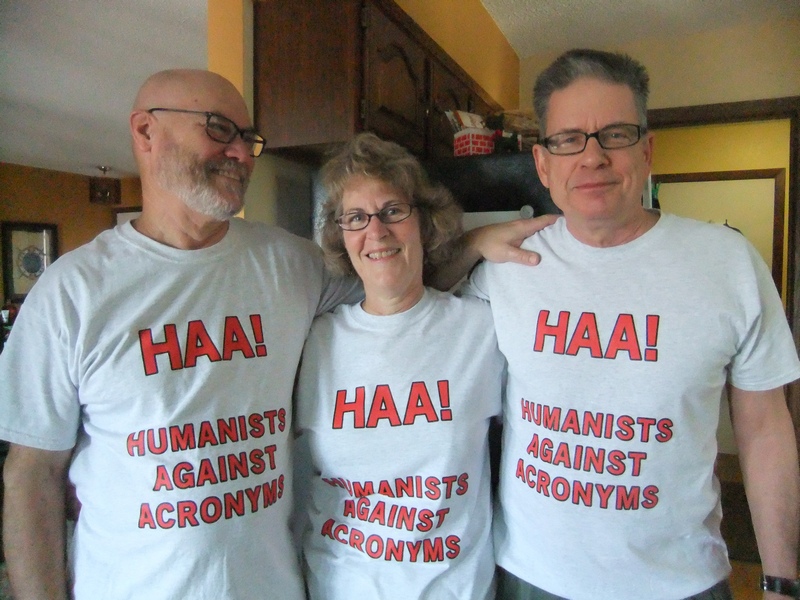
Greg (right) and his friends Steve and Kris Petrini.

Several years ago, I made up tee-shirts to score a point against  the demeaning and diminishing influence of acronyms. I meant these HAA!, or Humanists Against Acronyms, tees to battle the forces of modern life (scientific, technical, institutional) that reduce and insult us both as individuals and as societies.

Other forms of language, like jargon, may be equally divisive. Today’s political language bristles with know-it-all and in-your-face jargon: politically correct, woke, RINO, fake news, and dog whistle. 

Some of these terms are turned on their heads by political opponents, of course: politically correct, or PC, and woke are often used as terms of opprobrium. You might argue that sleepyheads of all persuasions — that is, ideologs — are fond of bending the language of the opposition to their own end. But any language, used too often to mean the one correct, permissible, and praiseworthy thing, without persuasion or support, becomes abusive.

I felt just so, I must admit, when I read the other day in an essay by bell hooks the label white-supremacist-capitalist-patriarchy. Oof! what a mouthful! It’s not just that this phrase is long and ugly, it’s that it is ideology that piles up accusations and levels them against society as a whole, or white society as a whole. Ordinarily, I think hooks writes very well, gracefully and not didactically, so that the reader is persuaded to listen attentively and consider her arguments carefully. But this phrase is not an argument but an accusation, a clunker. It’s a clinker that won’t burn. A dog that won’t hunt. It’s preaching that won’t win over anyone who’s not already in the choir.

Of course, much of American society, in many ways, has elements of racial supremacy, capitalism, patriarchy. (The white man still rules, decides wages, takes profits, throws his weight around, endorses hierarchy.) But hooks’ characterization is not the way that American society as a whole works. It’s not an accurate or adequate characterization of who we are and where we’re going as a people.

Not all of us fawn over Donald Trump, who’s innocent of all ideas except self-exaltation, or Ron DeSantis, who’s been busy indoctrinating his followers against forms of indoctrination other than his own.

DeSantis against African-American AP.
DeSantis and the Florida Department of Education have outlawed teaching racism in an African-American Advanced Placement course.

Those who see the injustice in rigid political positions, and the ideologies that support them, will fight back against their excesses, whether these are left-wing or right-wing positions. In doing so, they might well feel they’ve earned some respect. 

As an alternative to bell hooks’ white-supremacist-capitalist-patriarchy, I suggest we resort to a less offensive, if more opaque, acronym. Something like WSCP (pronounced wusscup). I know, I know. Acronyms are ugly, but can occasionally afford comic relief.

And sometimes humor and humility are what we need a lot more than being correct, whether left or right, in whatever activity we’re active in. Let’s have a good laugh and return to illuminating discussions.