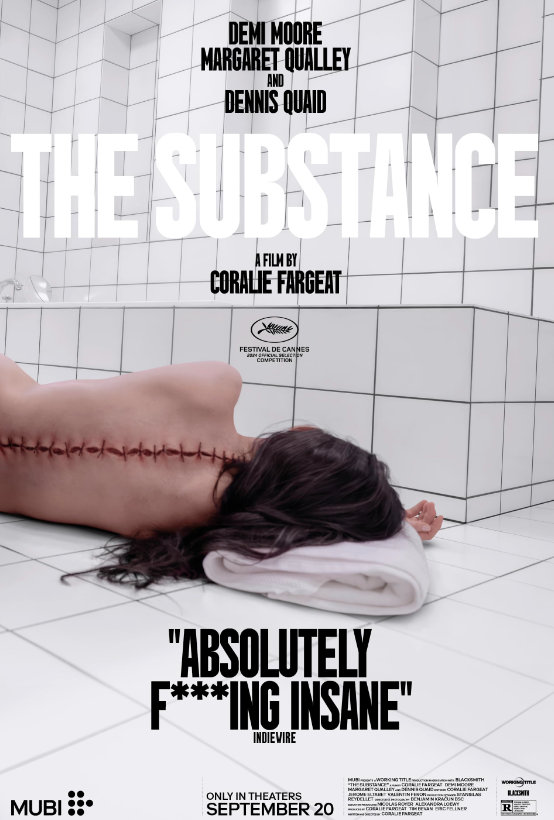
Recently with my son I attended a viewing of Demi Moore’s new film The Substance — which is an icky one indeed, including tons of barfing, bleeding, and fleshly grotesqueries. I liked the film, despite my general aversion to sci fi and horror. This was a film that indulged yet transcended the pop genres.
It’s a fable about the difficulties (horrors) of growing old in a youth- and beauty-oriented culture, both in Hollywood and the hinterland. The protagonist of the film, Elizabeth Sparkle, played by Demi Moore, is a TV aerobics star but at the nadir of her apex. She’s 50 years old or so, in other words, and her studio boss, played by a hilariously despicable Dennis Quaid, tells her she’s through. The show needs fresh meat.
To make a long, long story (two hours, twenty minutes) short, she makes a Faustian bargain for something called the Substance, ducking into a back alley as if for an abortion and finding, every time she does so, in an immaculate and sterile room, a rejuvenating kit with instructions.
Back home at her luxury penthouse, Elizabeth shoots up and falls to the bathroom floor, writhing, quaking, her back splitting open grotesquely — not exactly Eve from Adam’s rib but a much younger version of herself, a gal named Sue (Margaret Qualley), who will go on to take Ms. Sparkle’s part on the aerobics show.
Thing is, the instructions make it clear that the two women must change places every week. There is only so much of the substance, apparently, and when Sue is done with her week she must yield to Liz. But Sue cheats, syringing out more days’ worth of the substance from Liz’s back, through a gaping, sucking porthole, than is specified. When she overdoes her stay by a day or two, Liz grows older.
The first sign of this aging is a bony index finger — crooked, scaly, brown! — the first sign of a rapidly advancing infirmity, thanks to Hollywood’s special yucky effects department.

Sure, Sue goes on to become the aerobics star, if only briefly, and then to be signed to lead a spectacular New Year’s gala, but she too succumbs to the Substance. As the gala is to commence, she lurches onstage, late, hunched over, over her face a piece of paper smeared with a red lipstick mouth. What better reaction to Quaid’s admonition that “pretty girls always smile”?
Critics have knocked the film as too much horror, and too many grotesque special effects, and it is pretty difficult to sit through for as long as it goes on (especially the ludicrous blood- and yuck-spewing of the final scene at the New Year’s show).
But it’s a powerful fable, as I say, of the illusions of our day. Do we need to be knocked over the head (barfed on) to get the point? Apparently. How many of us won’t go home from the viewing without thinking (shuddering) not so much about losing our youth … but about losing our minds to the infantile preoccupations with youth and appearance?
True, there’s no character in the film, no authorial point of view that stands for the critic, that develops a complex critical thesis, but, hey, this is the movies. It’s a corporeal film and delivers a corporeal impact. Not only the barfing and bleeding and spewing of all kinds, but the more sedate, even painterly nudity: I didn’t mind seeing a naked Demi Moore, even at 50, and her younger self, played by Margaret Qualley, half her age, but these images do not appeal to prurient interest (at least not mine).
I’m not 26 anymore, or even 52, but I look at the gray in my hair, the wrinkles in my face, the keratoses on my skin, and laugh. The maculae, the imperfections, are what I’ve earned — how about you? — by living the perilous adventure we call life.