To continue sweating over what may be the beginning of a poem, a new poem, maybe an ekphrastic poem (done in imitation of another objet d’art).
To continue sweating, and yet swearing it’s no sweat, it’s fun. At least that’s how I find playing with language, and playing is the essence of the game. It’s form more than content, especially at the start, and form creates the content that is.
“I gotta use words when I talk to you,” said T. S. Eliot, another crucial modernist. But what words, what words we talking here?
Our own, we would hope, even when interfused with those of the poet we are imitating. For if imitation is flattery it also may mean flattening, drowning in another’s voice.
So taking up, carefully, consciously, playfully, where we left off:
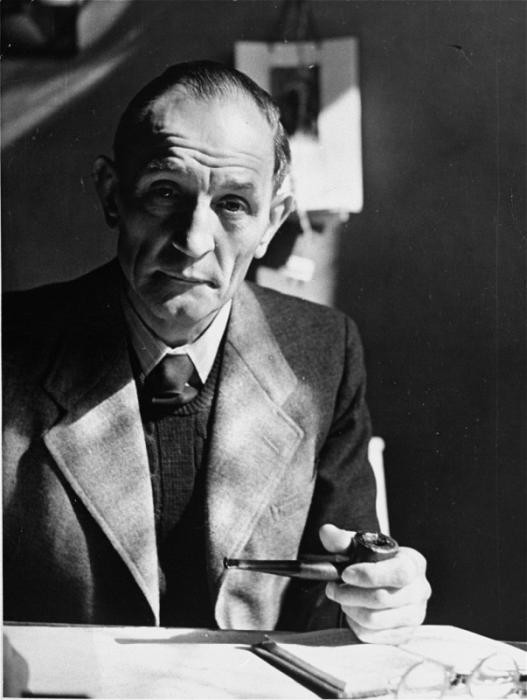
Yet what he said who knew? He was poet,
after all, not executive, not poohbah
of the boardroom. He wrote,
he did not underwrite. He took,
he did not undertake. He was
focused, not schizwit.
This is pretty tight but, sure, frankly imitative of Stevens: especially poohbah and schizwit. If this is a tribute, an ekphrasis, that’s one thing. But it if means to launch out, rocket like, from the gantry of another’s voice, that may be something else altogether. Will these words, launched, in other words, find their own orbit?
To this end, let’s play around with what we have, taking out the Stevensian effects:
Yet what he said who knew?
He was poet, after all, not
executive. He would not
sit godlike at the head,
executing policy,
throwing thunderbolts,
but enforce it. He would
write, not underwrite.
Take, not undertake,
the letter of the law,
and when he left
the office for his
home, walking
back the three
miles he had
trod that
morning,
the letters
formed in
glory, in
full words,
and he wore
them like the
helmet of the sun
god that
he was.
Well, good gods, I have gotten ahead of myself here, you see. Forgotten that I was to shape the sestet into another sestet. Got wordy, perhaps, adding ideas but not yet shaping them.
Proof if anything that I may be in the early stages of development. But let that be as it may. I can always go back, recursively, you see, and press and mold these words into six-line stanzas if that’s that they seem to want or warrant.
But now merely letting some ideas play, along with the nascent shapes and sounds of the words. Here it’s the idea that Stevens didn’t want to be too much a businessman or lawyer, though he was that gladly during the workday. From what I surmise in the Brazeau book (see yesterday’s post), he would sometimes fiddle around with words in the office, even have his secretary type up a few lines, and then he’d stash ’em in the lower right-hand drawer of his desk.
But as I’m fooling around here I’m operating under poetic license, with no oath of fidelity to the letter of the law or the law itself.
The office was one realm for Stevens, an earthly realm. The home, and the walk home, were another, a celestial realm, a place of resting from work and wrestling with the angel of the word, a place of contemplation (aside too from the wife, with whom Stevens did not share a bed or bedroom for many years, for poetry was his muse, his mistress, you see).
As a matter of course, to make the process clearer, I take early versions of a poem, early drafts, and print them up as I go along. Let them rest and breathe on the desk a day or two. Fiddle with them with my pencil, crossing out certain words or phrases, asking questions. And then waiting for the next, I hope clearer, vision of the whole when I come back the next day and have at it.
So let’s see what will happen tomorrow, shall we? Or what already has?